
![[Preview] Sword of the Sea is a magnificent, magical flow state on oceans of sand](https://www.sidequesting.com/wp-content/uploads/sword-of-the-sea-preview.jpg)
Giant Squid Studios brings an emotive dance to deserts with Sword of the Sea
“How much time do I have left in my demo?”
“You’re fine. You’re booked for an hour.”
“OH YES. YES YES. AWESOME.”
After only a half hour into my demo of Giant Squid’s Sword of the Sea at Summer Game Fest earlier this month I wanted to play it and only it. Everything about this game, from its art direction to its themes, to its gameplay and its mystery, had its hooks so deep into me that I didn’t want to stop. I was in love, I wanted more, and I was happy to get another half hour. In a typical expo our demo sessions are guided, strict, or meant to hit very specific points in order to get the full gist of what a game is delivering. But this game felt different.
“There’s no tutorial, just go. Have fun. You don’t need our help.”
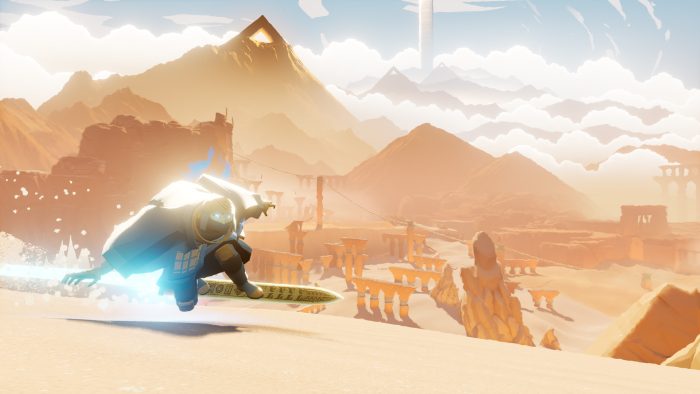
As PR handed me the PS5 controller, I began to move my glowing cloaked figure, proceeding to grab a strange giant sword and jump on top. Then, I was off. I was moving, sliding across embankments, in half-pipes made of stone, over oceans — yes, oceans — of sand. And while it’s a desolate, sometimes stark and always dry environment, the magic of the movement amongst all of it is serene and peaceful, and ultimately full of life.
I never thought sand could move like this.
And, sand doesn’t. But for Matt Nava, the Art Director behind Journey and ABZU and The Pathless, and the mind behind this game, sand *can* move like this, and we can move along with it. There are layered themes within Sword of the Sea, and they’d take more than an hour long session to get too far into, but life and environmentalism are evident everywhere through our actions. That’s because we quickly discover our goal, at least for this immediate area that the demo takes place in: bring the sea, the liquid one, back to the world.

But first, that incredible motion. The game wants us to know that we can and should move, and enjoy it. While surfing may be what we initially think about when we talk about a longboard and waves, the overall feel of the movement is more akin to snowboarding, albeit softer and yet with more purpose. We can speed up, slow down, we can move over a wave of sand and launch into the air, do a trick, and land back, always feeling incredibly natural. I’ve never surfed or snowboarded, or at least I haven’t yet, but this feeling in the game is so good, so pure, that if it’s even remotely close to the real thing then I never want to be on dry land again.
A part of that experience is because of the sand. It isn’t static, it’s alive. It moves like grainy liquid, but still liquid, and we cut through and into and over it — hey, we are riding a sword. The team has worked on a lot of games where motion is at the core, but this type of granular fluidity pushed them to new ideas.
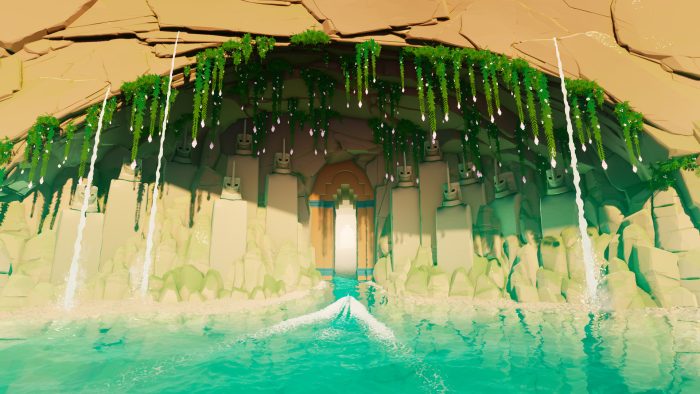
With my sword in hand (or rather, under my feet) I traverse around a giant open desert. There are things in the distance I can’t get to, but know that I’ll figure out how eventually, and things near me that entice me to dance and leap to get to them. The more I collect, the more that carrot of shiny objects is in front of me, the more I’m actually exploring and understanding this area. I jump to get a collectible, but then realize I can also jump the same way to get onto a platform or a whirlwind, which sends me onto the next one, which lifts me to an encolsure that I can explore. As I head into caves and temples I collect items, I activate things in order, and I eventually manage to flood them with life-giving water. Suddenly plants sprout and things get green, rooms shift, the dusty brown becomes a vibrant blue, and sea life even springs forth. No matter how many times I do it, I’m always taken aback whenever a whale swims past me.
We can solve these rooms in any order we want; the desert is vast, but it’s also meant to let us do things at our own pace. Just explore. Just go. We can and will eventually figure things out. Other temples have us riding half pipes to higher ledges, or going deeper underground, or flooding the overworld to sprout new platforms and take us to higher places. The world feels forgotten, but as we bring back the water we bring back the life, and suddenly all of it is alive.

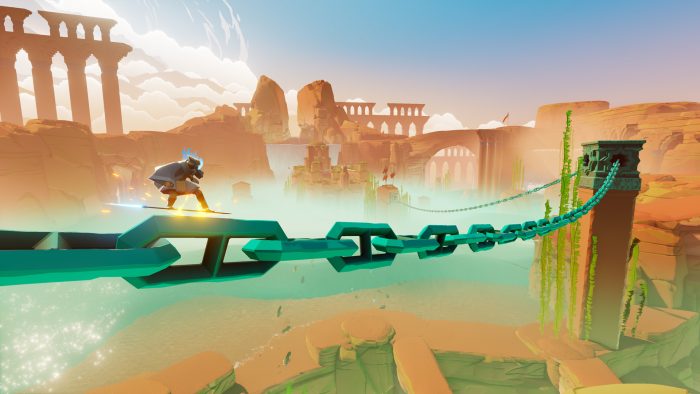
The finale of the experience, opening the doorway at an ominous central temple-like structure, has me riding massive links of chains across the length of the desertm to activate power sources, something I could only do once I learned from exploration, once I lived among those waves.
Of all the games I played at Summer Game Fest, Sword of the Sea brought perhaps the most memorable, the most meaningful hour of my weekend, and was easily my favorite project there. It’s been a couple of weeks, but I can still feel that motion, that movement, that a-ha of when I pull off a trick or revive a fountain. It’s perhaps fitting that when my hour is up and I take my headphones off I hear someone speaking behind me. “This is what game development is about, this kind of magic. This is the kind of experience that players will find most important to them.” I turn and notice Shuhei Yoshida, former President of SIE Worldwide Studios, had walked over and was talking about the game with a giant smile on his face.
Yes, this is magic. And I can’t wait to see what kind of magic comes from more of Sword of the Sea when it launches later this year for PlayStation 5 and PC.


No Comments