
Ruffy around the edges with the interesting platformer
Some of my favorite video games I’ve played over the years have been 3D Platformers, specifically the ones that put an emphasis on collecting various rewards hidden throughout the world. So when fellow Sidequesting writer Zach Quest shared the initial reveal trailer for Zockrates Labs’ Ruffy and the Riverside with me, I was instantly intrigued. And when I got to play the demo a year later I was absolutely enamored.
But when I got my hands on the final product that feeling didn’t last long, as it became quickly apparent that the demo remixed the level design in a way that felt more like those platformers I grew up with, such as Banjo-Kazooie and Donkey Kong 64. The retail version was nothing like this, instead playing like a faux open-ended world that pushed me down a linear path, taking away my agency in how I wanted to tackle exploration and progress.
Ruffy is an adorable bear who, along with his just as cute bee sidekick Pip, are chosen to rebuild their beloved town of Riverside after an evil cube named Groll steals artifacts and destroys the city sign in the process. It becomes our task to find the letters for the Hollywood-esque town sign, which somehow magically keeps everything from falling into chaos. The story is woefully silly, but has an annoying amount of badly written dialogue that takes itself way too seriously. It tries to implement the garbled voice work found in Banjo-Kazooie but the execution is terrible. With each line of dialogue all we get is one grunt, giggle, or laugh depending on the speaker; the rest of the line reads silently, or is interrupted by the noises of bystanders in the background.
Ruffy has the ability to take specific textures or colors and plaster them over other textures, transforming the level to help solve puzzles. If we need to reach the top of a waterfall all we need to do is place a vine texture over the waterfall, and the water changes into a climbable surface.
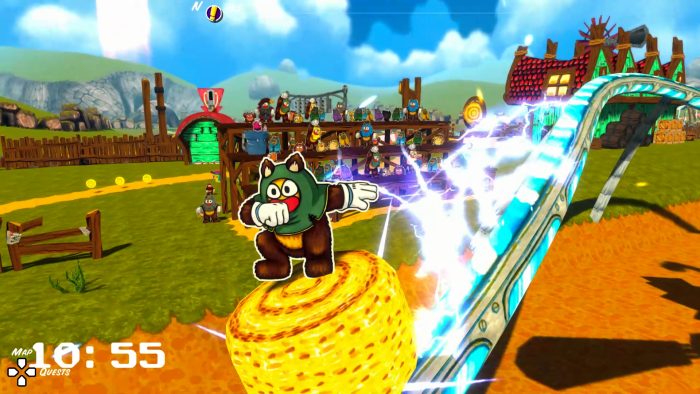
This core mechanic is really clever and not something I had experienced in a platformer before, but it’s held back as most puzzles are very basic or are recycled later on. When a solution is harder to come by it’s usually due to being obtuse and poorly designed. In one instance I had to reach an island, but with the first half of the bridge collapsed on the ground, I couldn’t jump to the other side of it. The solution was to turn the water into lava to burn the wooden pillars holding it up, letting it fall down at an angle I could reach it. It took me longer than it should to discover the solution because I spent nearly ten minutes trying to turn the top area of the bridge into stone or metal so it wouldn’t burn when it fell. To my surprise it had to be wood and the lava didn’t burn it, despite other puzzles requiring you to burn wooden items with lava.
When the game requires actual platforming it misses the mark due to janky controls. It’s incredibly easy to fall into water, quicksand or lava due to depth and camera issues. Not counting the bosses, there’s only three distinct enemy types and all you need to do is punch them. The aforementioned bosses are just as one note, lacking any sense of challenge.

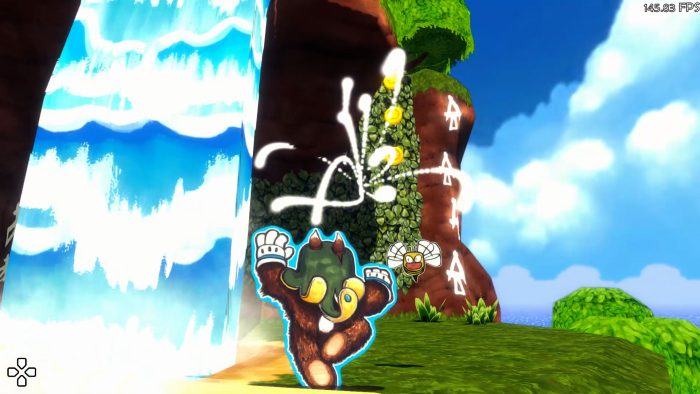
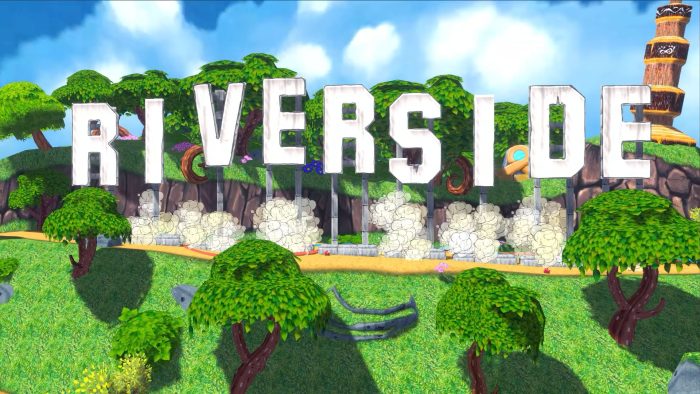
Throughout the lands Ruffy explores are dream stones, lost butterflies and creatures called Etoi to be found, among other collectibles. Turning these in rewards us with coins which are used to upgrade our health and stamina stats, which we don’t really need to do because the game is incredibly easy. I maxed out my stats a long time before I collected everything, and still had a surplus of over a thousand coins, so I just stopped looking for collectibles.
There are still aspects within Ruffy and the Riverside that have been crafted with great care and style, most notably the graphics and music. The art on display in both is stellar, feeling straight out of a first-party Nintendo game. But with everything else being so rough around the edges, Ruffy and the Riverside is an incredibly disappointing experience and not one I can really recommend to others.
This review is based on a copy of the game for Steam sent to SideQuesting by the publisher.


No Comments