
![[Hands-on Preview] Towa and the Guardians of the Sacred Tree brings roguelike team-building to the forefront](https://www.sidequesting.com/wp-content/uploads/IMG_0064.jpeg)
Towa focuses on roguelike adventuring, two heroes at a time
I have a love/hate relationship with roguelike games in that I *want* to love them but I *hate* having to wait for the inevitable lengthy tutorial that can take place at the beginning of so many. Just get me to the goods, man, so that I can play your game. I was 15 minutes into Towa and the Guardians of the Sacred Tree back at Summer Game Fest’s Play Days before. Realized that I had been knee deep in action the entire time, with nary a moment where I had to slow down to learn something.
And that, my friends, is a testament to how a good game can hook Players Like Me and deliver a really fun time.
Anyhoo, I had a 15-20 minute demo of the game earlier in the month, hands-on after a short presentation, and was happy to note that there was no waiting, no exposition, just “go and explore and fight things and use magic.” Towa has us taking on the role of Prayer Children, those very guardians that the title speaks of, as we fight back a miasma that’s overtaking our land. The game kicks off at a camp with us selecting two characters: one is our “Tsurugi”, or Sword who takes on most of the battle and action, and our “Kagura”, or Staff that offers support. As we travel the room-based worlds (our demo took place in the game’s early forests) we use twin-stick-like controls to launch our attacks between both of our selected characters (the left controls one character, the right controls the other). This idea of controlling two characters at once isn’t necessarily new, and it’s not a novelty by itself, but just being an action RPG that uses melee and magic may be enough to pull it across the line into “fresh idea.”
Combat requires a lot of swapping of tools and weapons so that our attacks stay consistently strong, and that’s needed because some of the monster rooms genuinely become thick with enemies. There can be A LOT of folk running around the rooms that we have to engage with, so remaining strong and nimble and making sure our attacks hit is key.
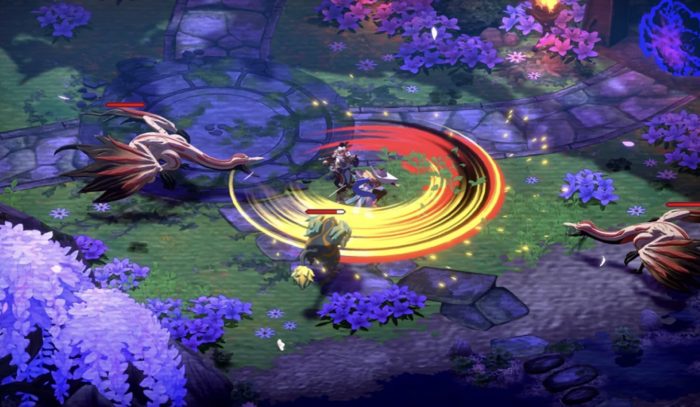
Just like any other roguelike, we gather resources at the end of a run — good or bad —and can use that to invest back into our character’s full-time stats. This becomes important as just as my run was looking successful I ended up getting blindsided by a weaker enemy (that I mistook for a portion of the background). I then am jetted back to the encampment to select another new character lead and support, and try my run again. It’s this second run with a different team that ultimately lets me get further into the world and understand its machinations.
Towa incorporates Eastern principles and mysticism, and that’s reflected all throughout the level designs. Forests are rich in color, vibrant in life. The game’s plot is explained quickly, but the livingness of the world helps to tell it without much text. It’s this juggling of world design and gameplay that I’m perhaps most excited about with this project, and really seeing how the characters work within the plot and its shifting.
Towa and the Guardians of the Sacred Tree launches this Summer.


No Comments